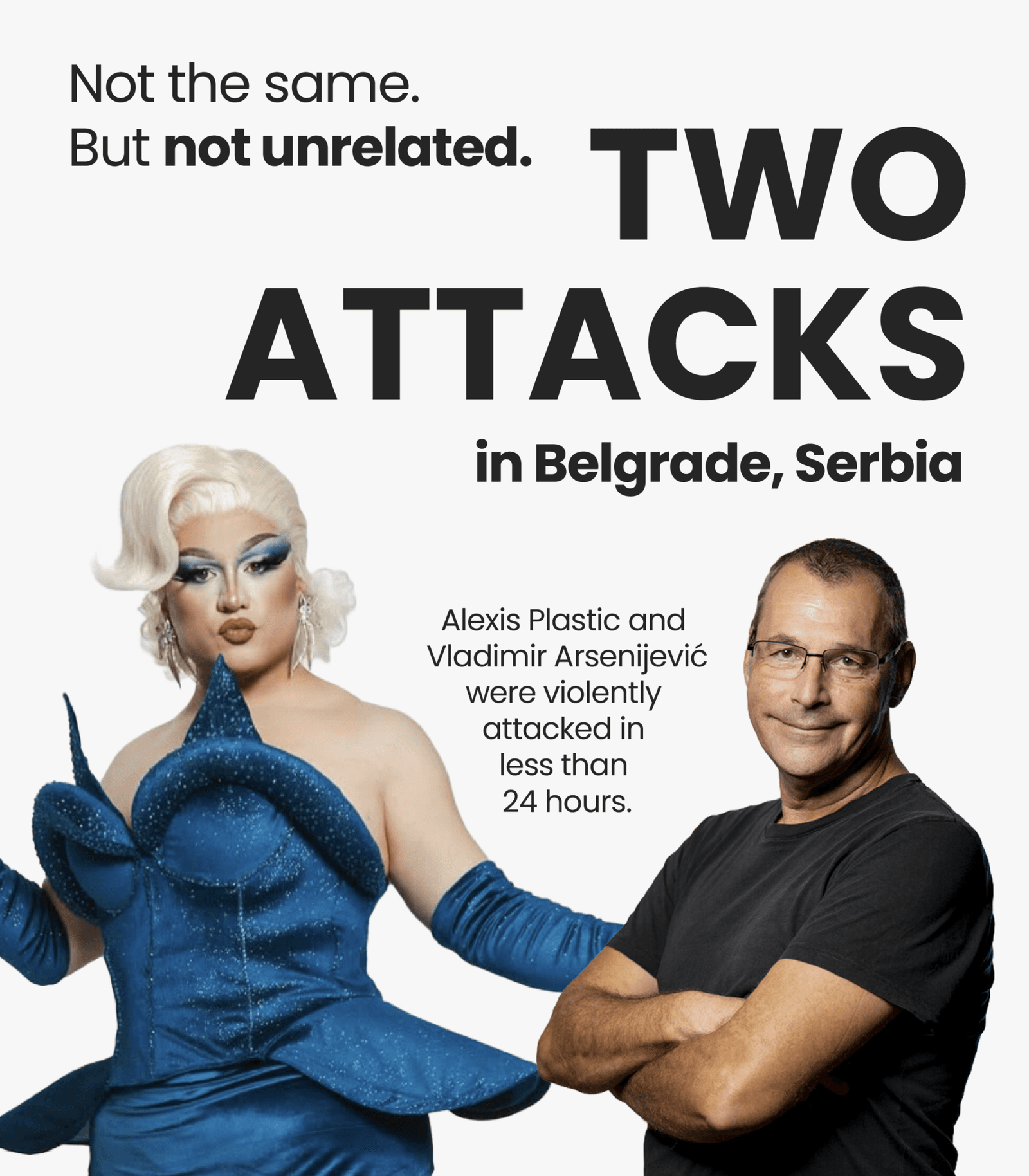
Not the Same. Not Unrelated.
Within less than 24 hours, drag artist Alexis Plastic and writer and KROKODIL Festival Director Vladimir Arsenijević were violently attacked in Belgrade.
The two attacks took place in different circumstances and targeted people engaged in different areas of public and cultural life. They must not be treated as identical, nor should their individual contexts be erased. However, they are not unrelated.
Both attacks used violence and intimidation to send a message about who is allowed to be visible, who is allowed to speak, who is considered to belong in public space and whose experiences and memories society is prepared to protect.
Attack on Alexis Plastic
Alexis Plastic was attacked in Belgrade’s public transport after, according to information shared about the incident, the assailant noticed an item carrying LGBTIQ+ symbols.
During the attack, Alexis sustained an injury to the eye and a puncture wound to the leg caused by a key. The wound required surgical treatment and stitches.
Belgrade Pride described the incident as an attack motivated by homophobia and called on the competent institutions to urgently identify and prosecute the person responsible.
The attack is a reminder that, for many LGBTIQ+ people, visibility in public space continues to carry a real risk. An object associated with the community, a person’s appearance, gender expression or perceived identity can still become a trigger for verbal harassment, threats and physical violence.
This is precisely how hate-motivated violence operates. Its consequences extend beyond the person who is directly attacked. It sends a warning to an entire community: hide what identifies you, make yourself less visible, avoid drawing attention and calculate whether expressing yourself openly is safe.
No person should have to make such calculations when entering a bus, walking through the city or taking part in everyday public life.
Attack on Vladimir Arsenijević
Earlier that day, writer and activist Vladimir Arsenijević, founder of the KROKODIL association and KROKODIL Festival, was physically attacked beneath Branko’s Bridge in central Belgrade.
Arsenijević was at the site to help prepare a commemoration dedicated to the victims of the Srebrenica genocide. The event had been announced as part of the programme organised by civil society organisations, foundations, artists and activists gathered around the People Remember People coalition.
According to Arsenijević’s public account, a group of approximately 20 to 30 young people was waiting at the site. He stated that members of the group insulted, threatened, struck and kicked him, while messages were written across the space intended for the commemoration. Photographs and video published after the incident showed visible injuries to his face.
The planned gathering was subsequently cancelled because organisers assessed that the safety of participants could no longer be guaranteed. Police conducted an examination of the scene, while institutions, diplomatic representatives and civil society actors called for a prompt investigation and prosecution of those responsible.
Violence in this context was not only directed at one person. It disrupted a peaceful act of remembrance and made a public gathering impossible by creating fear and an immediate security risk.
Different attacks, a connected political environment
The attack on Alexis Plastic and the attack on Vladimir Arsenijević are not the same.
Alexis was targeted in an incident motivated by homophobia. Vladimir was attacked while preparing a commemoration and participating in work dedicated to public remembrance.
However, both attacks expose the consequences of a political and social environment in which certain people are repeatedly presented as undesirable, threatening or less entitled to occupy public space.
In one case, violence communicates that an LGBTIQ+ person should not be openly visible. In the other, violence communicates that people should not publicly challenge denial, insist on remembrance or create space for difficult conversations about the past.
In both cases, fear is used as a political tool.
The objective is larger than injuring one person. It is to influence the behaviour of everyone watching: to discourage LGBTIQ+ people from expressing themselves openly, activists from organising, artists and writers from speaking publicly, and citizens from participating in acts of remembrance or defending human rights.
These are not abstract debates, isolated acts of offensive speech or individual conflicts. When hatred is normalised, when threats remain without consequences and when those who use violence expect impunity, physical attacks become increasingly likely.
Across the Western Balkans, homophobia, transphobia, historical revisionism, nationalist intimidation and hostility towards human rights defenders often reinforce one another.
They draw from the same politics of exclusion: dividing society into those who supposedly belong and those who do not; constructing internal enemies; controlling which identities may appear in public; and treating people who question dominant nationalist and patriarchal narratives as legitimate targets.
This is why ERA, as a regional LGBTIQ+ organisation, cannot understand the safety of LGBTIQ+ people as an isolated issue.
LGBTIQ+ rights cannot be separated from democratic freedoms, the protection of civic space, freedom of expression and the right of citizens to organise, remember and defend human rights without fear.
A society that tolerates violence against one group does not become safer for others. It simply expands the number of people against whom violence may eventually be used.
Institutional responsibility requires action
ERA strongly condemns both attacks and stands in solidarity with Alexis Plastic and Vladimir Arsenijević.
We call on the Serbian authorities to act without delay: to identify and prosecute all those responsible, fully investigate the motives and circumstances of both attacks and ensure the safety of those targeted.
The investigations must address not only the immediate acts of violence but also whether the attacks were motivated by hatred, organised intimidation or an intention to prevent people from participating freely in public life.
Institutional responsibility cannot be reduced to statements of condemnation issued after someone has already been injured or a public event has already been forced to close.
It requires effective protection, swift and transparent investigations, consistent prosecution and a clear response to the wider climate in which homophobia, transphobia, nationalist intimidation and hostility towards human rights defenders are increasingly normalised.
Failure to respond decisively does not leave the situation unchanged. It communicates that threats may be effective, that violence can successfully remove people and ideas from public space, and that those who attack may expect few or no consequences.
Public authorities have an obligation to protect every citizen equally, regardless of their actual or perceived sexual orientation, gender identity, gender expression, political position, profession or public engagement.
They also have an obligation to ensure that public transport, streets, cultural venues and spaces of peaceful assembly remain accessible and safe for everyone.
Freedom cannot be selective!
There can be no meaningful safety for LGBTIQ+ people in a society where hatred, violence and impunity are allowed to decide who belongs, who may speak and who may be remembered.
Belgrade, and every city across our region, must be a place where people can live openly, express themselves, participate in public and cultural life, preserve memory and defend human rights without fear of violence.
Solidarity is more than standing beside those who have already been attacked.
It is our collective refusal to allow violence to determine the boundaries of our freedoms.